The story of White House solar panels is much more than a mere story of renewable energy technology. It is a potent icon of American wavering dedication to environmental guardianship as well as a reference point when evaluating the impact of political determination on national energy policy. Since their installation to their taking down and subsequent reintegration, these solar panels have challenged the commitment of every administration to the principles of sustainability, and have shown the intricate connection between politics and environmentalism.
The Carter Era The Era Establishing the Presidential Leadership on the Environmental Front
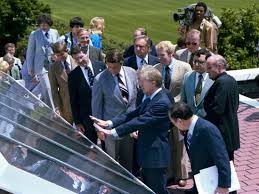
One such declaration was the installation of 32 solar thermal panels on the roof of the White House by President Jimmy Carter in 1979. This historic ruling set a precedent in presidential leadership on the environment in an era of an energy crisis and increased environmental sensitivity. The solar panels in the White House were not a simple tool used in heating water; they were the vision of Carter on how America would be powered in future, and how he thought America had to adopt renewable sources of energy. Carter gave the installation ceremony during which he prophesied that these panels would continue to generate power even in the year 2000, representing his wish to have a sustainable energy transition.
The Ronald Reagan Administration A Test of Continuity Failed
The actual environment test was when the administration changed. The future of the solar panels at the White House was also in doubt when Ronald Reagan assumed office in 1981. The priorities of Reagan were completely different as compared to those of his predecessor who had emphasized more on deregulation and fossil fuel development. During roof repairs in the year 1986, the solar panels were silently taken down and have never been put up again. This move challenged the sustainability of environmental projects and showed how dangerous such undertakings could be to political changes. When the White House solar panels were taken down, this was a clear signal that renewable energy was not on the agenda as a bipartisan issue but rather a political football that can be moved around with the change of administration. The Reagan years set a disturbing precedent of environmental policy turnover where it was revealed how easily a symbolic effort at sustainability could be revoked as politics falters.
Decades in Exile The Panels as Political Test Case
Over twenty years without White House solar panels could be considered as lying reminder of the patchy commitment of America to environmental concerns. These panels installed by Carter were given to Unity College in Maine, where they served a few years, which was a real irony considering how long they lasted and how efficient they were. This was a time that put to test every future administration that was to come, whether they would be bold and stand by their principles to revive the use of solar technology to the most renowned home in the country. The Bush administration of George H.W. Bush and the administration of Bill Clinton were unsuccessful in this test, though there were different levels of environmental rhetoric. Although climatology became more and more conclusive and renewable energy technologies gained leaps and bounds, the White House was free of solar panels, and its roof was a symbol of missed opportunities and political shyness regarding environmental matters.
The Obama Revival Testing the Modern Environmental Dedication
In 2013, the installation of the new solar panels by President Barack Obama was a turning point in the story about the solar panels in the White House. The case was a challenge to the contemporary political leaders to see what they could learn not to make the same errors as before and to prove that they cared about the environment. The solar panels that Obama had were well advanced than the thermal collectors that Carter had by including photovoltaic cells which could produce electricity. Such upgrade was a mixture of technological advancements and the new political mood to solve climate change. The Obama administration made the White House solar panels a teaching tool creating a new framework of federal leadership in renewable energy. This installation was a test of how well the administration can convert their environmental commitments into tangible action, and the Obama team passed this test by not only putting up the panels but also instituting more widespread clean energy programs at federal facilities.
The Trump Era Putting Environmental Resilience to the Test
Upon the entrance of Donald Trump to power in 2017, environmental activists were holding their breaths, hoping that the history will not repeat itself. Would the White House solar panels be removed again just like it had been done during the reign of Reagan? This was the time when the environmental infrastructure has been put to the test in this administration that largely dismisses climate science and is determined to push fossil fuel. Notably, even after Trump pulled out of the Paris climate treaty and repealed several environmental protection policies, the solar panels on the white house were still here. It was unclear whether this was an intentional decision or an innocent omission but it showed that certain environmental gains were now normalized at a degree where they can be passed on to a new administration. This passive continuity though by no means perfect, provided a new level in the sense that some of the environmental steps had attained some permanence which no one had ever dreamed possible.
Measuring Presidential Dedication The Solar Panel Litmus Test
The White House solar panels turned into an unofficial test of Presidential environmental commitment, they have become a tangible point of reference against which to compare rhetoric and action. The manner in which each administration handles these panels shows more about their priorities on issues that concern the environment and their political boldness. The panels are used to determine how the priorities of the Presidents are partisan or national security, whether they prefer to achieve short-term political gain to the long-term sustainability and whether the Presidents have a vision to create a cleaner energy future of America. The test is not symbolic but a fundamental issue on how American leadership, dealing with the global environmental issues, as well as government participation in setting the example of sustainable activities to both citizens and businesses.
Conclusion
White house solar panels remain a story that challenges every new time administration regarding their environmental commitment and political will. With climate change picking up and the necessity to find renewable energy becoming a pressing issue, these panels still carry a strong image and are also an experimental way of leadership. They set a minimum standard to which the leaders of America ought to walk the talk in the context of stewardship of the environment. This is a test which future administrations will take: Will they keep, build-up, or disregard the solar infrastructure on the most iconic building in the country? The answer will tell volumes of whether they were truly committed to solve the biggest of environmental issue facing humanity. White house solar panels fall to remind us that, environmental leadership needs not only words but also action that will be sustained, not only vision but the political will to stay true to that vision despite political change.